The Reality of Unsupervised AI in Your Business
A colleague just returned from two weeks on the Amalfi Coast. Beautiful weather, stunning scenery, the kind of trip people save up for. When you asked how it went, she paused.
“Honestly? I barely saw the coast. My laptop came everywhere.”
If you run a business in the Netherlands, that pause is familiar. Dutch entrepreneurs and SME owners consistently rank “inability to disconnect” as one of their top sources of professional stress — and yet the structural fix is rarely discussed. The conversation tends to stop at “delegate more” or “trust your team.” But delegation without systems is just wishful thinking.
The real problem is not dedication. It is dependency — specifically, a business infrastructure that cannot keep running without the owner at the centre of it.
This blog outlines the five things every Dutch business owner should be able to completely ignore while away, and explains what it takes — from a practical IT and operations standpoint — to make that possible. Whether you manage a 10-person consultancy in Amsterdam, a logistics firm in Rotterdam, or a growing services business in Eindhoven, the principles are the same.
Why this matters now:
The Netherlands IT Services market reached an estimated $28.71 billion in 2025, with SMEs growing fastest at a 15.52% CAGR. Dutch businesses investing in managed IT services are not just buying technical support — they are buying the operational freedom to step away.
1. Your Inbox
What it looks like now
You are halfway through dinner in a candlelit restaurant in Lisbon. The food is good, the conversation better. Then your phone lights up. One email becomes five. Five becomes a reply thread that takes thirty minutes to resolve. By the time you put the phone down, dinner is cold and the moment is gone.
For most Dutch business owners, email is not a communication tool — it is a dependency loop. Requests escalate to you because the process assumes your involvement. This does not stop when you fly.
What it should look like
You have an out-of-office that your team does not need to override. Requests are handled by the right people, through the right systems, without needing your name in the thread. If something is genuinely urgent, one designated contact reaches you through one agreed channel. Everything else waits.
What makes this possible in practice
- Clear ownership and decision authority distributed across your team, not concentrated at the top.
- IT systems that reduce “chase” emails — ticketing tools, shared inboxes, workflow automation — so fewer things need manual escalation.
- A communication policy your team understands and follows, including what qualifies as truly urgent.
The underlying issue:
When every meaningful decision flows through you, nothing runs without you. Managed IT services in the Netherlands increasingly include workflow automation and ticketing as standard — tools that reduce email bottlenecks without adding headcount.
2. Day-to-Day Tech Issues
What it looks like now
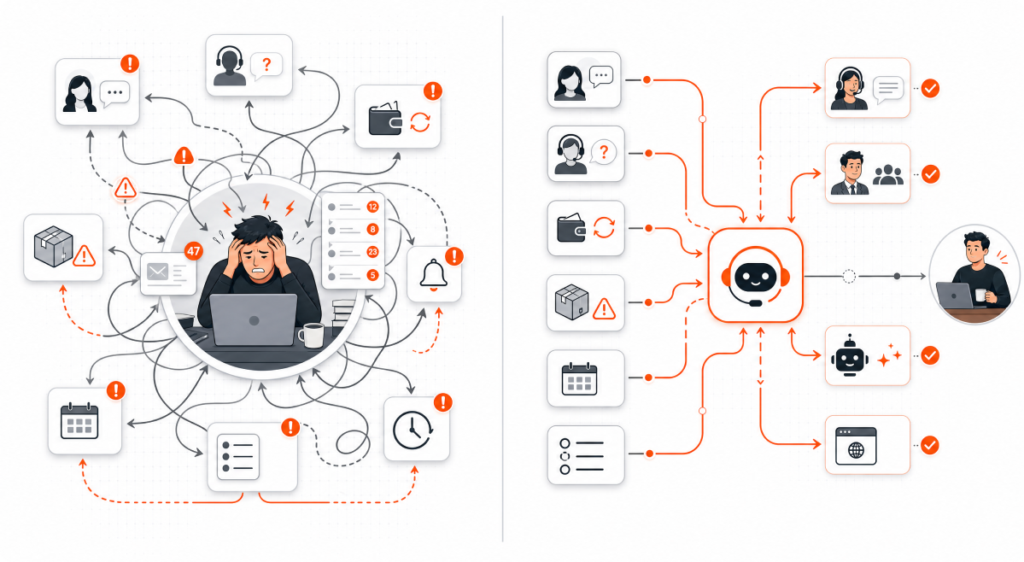
The Wi-Fi is acting up. The shared drive is throwing access errors. Someone’s laptop will not connect to the VPN. These are small problems individually, but they accumulate — and somehow, the path of least resistance always leads back to you.
In many Dutch SMEs, the business owner functions as an informal IT helpdesk. This is not just inefficient; it is a structural risk. When the informal helpdesk is unavailable, small problems escalate into lost hours, frustrated clients, and avoidable downtime.
What it should look like
Tech issues are resolved before you hear about them. Problems are logged, triaged, and fixed through a defined support process. Your team knows where to go for help, and it is not your mobile number.
What makes this possible in practice
- A managed IT support provider or dedicated helpdesk with defined response SLAs — ideally 24/7 coverage for critical issues.
- Proactive monitoring tools that detect and flag anomalies before they become outages.
- Standardised hardware and software configurations across the team, which dramatically reduce the variety of issues that arise.
According to research on the Dutch IT market, 21% of Dutch firms still cannot fill key IT roles internally — a gap that has only widened as software developer salaries rose 11% in 2024. For most SMEs, building an in-house IT team is not realistic. Partnering with a managed services provider fills that gap at a predictable monthly cost.
Real-world example:
A 25-person professional services firm in Utrecht moved from ad hoc IT support to a managed IT services contract. Within three months, average issue resolution time dropped from two days to four hours. The managing director’s phone stopped ringing about IT entirely — including during her first uninterrupted holiday in four years.
Monthly tech tips for SMBS
Quick, useful tech tips to help your business run better. We don’t send often — but when we do, it’s worth opening.
3. Day-to-Day Team Questions
What it looks like now
You step away for a long weekend in the Ardennes. By Sunday afternoon, your WhatsApp has seventeen messages. Not emergencies — just questions. “Can I approve this invoice?” “Should I reply to this client?” “How do we handle X again?” Questions your team could answer, but defaults to you for instead.
This is not a trust problem. It is a clarity problem. When roles, processes, and decision boundaries are not explicitly documented and embedded into the way your business operates, you become the implicit answer to everything — whether you are in the office or on a hiking trail.
What it should look like
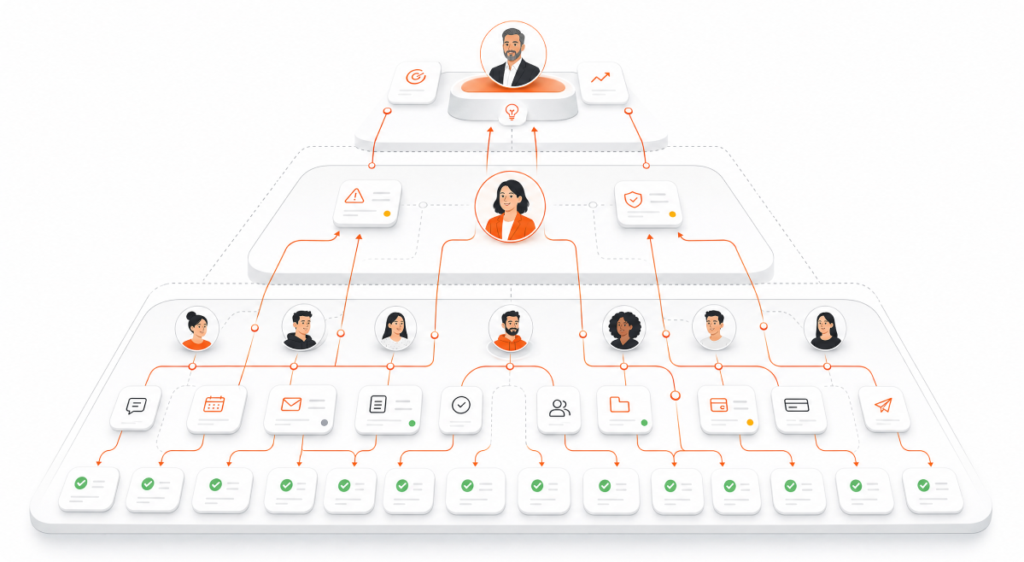
Work continues at normal pace without you in the loop. Your team has the information, the authority, and the tools they need to keep moving. You are not the default approval step.
What makes this possible in practice
- Documented decision frameworks: which decisions team members can make independently, which need escalation, and to whom.
- Project and task management systems (like Microsoft 365, Asana, or Monday.com) that give everyone visibility without needing to ask you for status updates.
- Clear role descriptions and process documentation — stored somewhere accessible, not just in your head.
This is one area where IT directly intersects with operations. The tools your business runs on — collaboration platforms, cloud-based document storage, shared project boards — either support autonomous working or create bottlenecks. Getting the right setup in place is not an IT luxury; it is a management necessity.
Worth noting:
If your team cannot make decisions without you, the issue is not your team. It is the absence of a system that enables them to. Dutch SMEs that implement proper cloud-based collaboration tools report a measurable reduction in owner-dependency within the first 90 days.
4. Customer Requests and Routine Issues
What it looks like now
A client calls the office and asks for you by name. Your team handles it well — until the issue gets slightly complicated, at which point the client is put on hold while someone scrambles to find a workaround or track down information that only you have access to.
Customers asking for you specifically is a compliment — until it becomes a dependency. When clients can only get a satisfactory outcome if you are personally involved, your business has a scalability ceiling, and your holidays have a time limit.
What it should look like
Clients receive consistent, high-quality service regardless of who is available. Issues are resolved through clear processes, shared CRM access, and a team that is genuinely empowered to help — not just to relay messages until you return.
What makes this possible in practice
- A shared CRM system where client history, preferences, and open issues are logged and accessible to the whole team.
- Clear service protocols: how issues are categorised, prioritised, and resolved at each level.
- Proper handover documentation so any team member can handle common client scenarios with confidence.
For Dutch businesses operating under AVG (the Dutch implementation of GDPR), there is an additional consideration: client data needs to be stored securely, with controlled access, on compliant infrastructure. This is not just a legal requirement — it is also the foundation of a service model that does not collapse when one person is unavailable.
The scaling truth:
If your clients need you personally to get what they need, your business cannot grow beyond what you can personally handle. Managed IT services in the Netherlands increasingly include CRM integration and cloud-based document access as part of a standard continuity package.
5. The Question “What If Something Goes Wrong?”
What it looks like now
You are sitting on a terrace in the south of France. Nothing is wrong. And yet the question is there, in the background, like a quiet hum you cannot quite switch off. What if the server goes down? What if there is a security breach? What if someone sends the wrong thing to the wrong client?
This is the hardest thing to ignore, because it is not triggered by anything external — it comes from the absence of certainty. And the only thing that resolves it is knowing, structurally, that your business can handle problems without you.
What it should look like
You are not thinking about work — not because nothing can go wrong, but because you know it will be handled if it does. You trust the systems, the safeguards, and the people responsible for managing them. Your peace of mind is backed by process, not hope.
What makes this possible in practice
- Automated backup systems with tested recovery protocols — and a documented recovery time objective (RTO) your team understands.
- 24/7 cybersecurity monitoring, particularly relevant given the Dutch market’s projected shortfall of 20,000 cybersecurity professionals by 2025.
- A clearly defined incident escalation process: who is responsible for what, what gets escalated, and at what point you are contacted.
- Regular IT health checks and proactive patching, so the risk of a major issue during your absence is minimised before you leave.
This is not about building a fortress. It is about building a predictable, monitored environment where the probability of something catastrophic is low — and the response to anything that does happen is fast and defined. For Dutch SMEs, this is precisely what a well-structured managed IT services relationship provides.
A Practical Example: How One Dutch SME Got There
A managing partner at a 30-person financial consulting firm in Amsterdam had not taken a holiday without a laptop for six years. The business was profitable and growing — but it was built entirely around her availability. Every significant client question came to her. Every tech issue landed with her. Every out-of-ordinary decision waited for her sign-off.
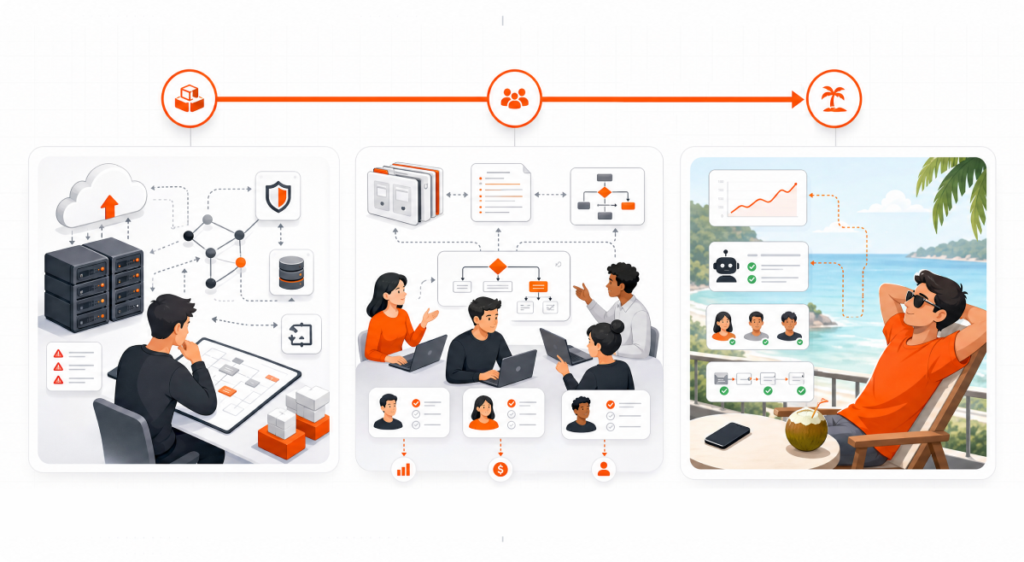
Over eight months, working with an IT partner and an operational consultant, the business made three structural changes:
1. IT infrastructure:
- Moved to a fully managed IT environment with 24/7 monitoring, a dedicated helpdesk SLA, and automated backups with tested recovery.
- Standardised all client files to a cloud-based document management system with access controls — AVG compliant, accessible to the whole team.
2. People and process:
- Defined which decisions each team member could make independently, with a single senior associate as the escalation point during absences.
- Documented client service protocols so any team member could handle tier-1 and tier-2 issues without escalation.
3. Communication:
- Implemented a single escalation channel (a dedicated mobile number, checked twice daily) for genuinely urgent matters only.
- Set a clear expectation with clients that the team was fully empowered to handle their needs.
She took three weeks off in the summer. The business ran. She checked her phone twice a day out of habit – not need. By week two, even that stopped
Where to Start: Actionable Steps for Dutch Business Owners
If you are not sure whether your business could run without you for two weeks, here is a practical starting point:
Step 1: Run a dependency audit
Write down every recurring decision, task, or contact that typically involves you. Categorise each one: Does it need me because of my expertise, or because the process assumes my involvement? The second category is where the work starts.
Step 2: Assess your IT infrastructure
Ask your IT provider (or yourself, if you manage it internally): What happens if a critical system goes down while I am away? Is there a monitoring system in place? What is the recovery time? Who gets called? If the honest answer involves you, that needs to change.
Step 3: Document the things only you know
Client preferences, system logins, vendor contacts, process quirks — if it only lives in your head, it is a risk. Spend two hours before your next holiday documenting the five things your team would most need if you were unreachable. Build from there.
Step 4: Get a professional IT assessment
Most managed IT service providers in the Netherlands offer a free or low-cost initial assessment. A 30-minute conversation can identify the most significant gaps in your business continuity setup before you need to find out the hard way that they exist.
Conclusion: The Holiday Is Not the Goal
Taking a proper holiday is one signal that your business is structured well. But the real value is not the holiday itself — it is the fact that a business that can run without you for two weeks also runs better when you are in it. It scales more easily, attracts better talent, serves clients more consistently, and is worth more if you ever want to sell or step back.
The five things covered in this blog — your inbox, tech issues, team questions, customer requests, and the background anxiety of “what if something goes wrong” — are not vacation problems. They are operational problems that happen to be most visible when you try to leave.
The right IT infrastructure does not just fix tech. It removes the structural reasons your business cannot operate independently. For Dutch SMEs, where talent shortages make building a large in-house IT team difficult, managed IT services are not a luxury — they are increasingly the practical foundation of a resilient, scalable business.
Key Takeaways
- A vacation-ready business is an operationally resilient business.
- The 5 things to ignore on holiday reveal the 5 structural gaps to fix now.
- Managed IT services in the Netherlands provide the infrastructure for real business continuity.
- The investment is not just in technology — it is in your ability to lead without being a bottleneck.
Ready to Find Out What Your Business Actually Depends On?
Most business owners are surprised by what the audit reveals. A quick 20-minute discovery call is enough to identify where your business is most exposed — and what it would realistically take to change that.
Book a free IT consultation today and find out what your business would look like if it could genuinely run without you.
No commitment. No jargon. Just a clear picture of where you stand and what the next step could look like.